|


|
Dedication of Indigenous Art QuiltJune 14 - 9:30amReconciliation Quilt DedicationOn the morning of June 14, we invite everyone to gather in the narthex at 9:30am. Cari K. will offer a blessing through a smudging ceremony, and together we will further bless and dedicate the quilt with a responsive litany. Riva, along with representatives from the Capilano Quilters have been invited as our special guests for this meaningful occasion. |
|
Traveling with the Ancestors of FaithDuring this long Season after Pentecost, you may notice something a little different in our readings from the Old Testament. In the Revised Common Lectionary, there are actually two possible sets of readings from the Hebrew Bible for this season. One set is called the “complementary” readings, where the Hebrew Bible passage is chosen to closely connect with the Gospel reading for the day. That is the pattern that has been usually followed at Gloria Dei in years past. The other option is called the “semi-continuous” readings. Rather than matching the Gospel theme each week, these readings invite us to journey through larger portions of Scripture over several months, allowing us to hear the unfolding stories of faith more continuously and deeply. This year, during the Season after Pentecost, which concludes on Christ the King Sunday in November, we will be using these semi-continuous readings. We are in Year A of the lectionary cycle, and in Year A the semi-continuous readings take us from Genesis through the time of the Judges. Over the coming weeks we will walk alongside Abraham and Sarah, and other figures of faith, listening to how God calls, forms, challenges, and blesses God’s people across generations. We pray that this deeper engagement with these stories of the ancestors of our faith will enrich our own faith and help us hear God’s living word afesh in our own time. If you would like to learn more about the Lectionary, Vanderbilt University has an excellent FAQ page here. And here's a video about Abraham and Sarah for kids.
|

|
Women’s Washroom Refresh Project – Volunteers & Paint Donations WelcomeThis is Lin. I am planning to refresh and refurbish the Women’s washroom beginning in July. If anyone has leftover paint that they are not using, donations would be greatly appreciated—especially white paint, though other colours are also welcome. If you are available and interested in helping with the painting project in July, volunteers are very welcome. It will be a simple and enjoyable project and a nice opportunity to work together as a community. Thank you very much for your support. Lin |
|
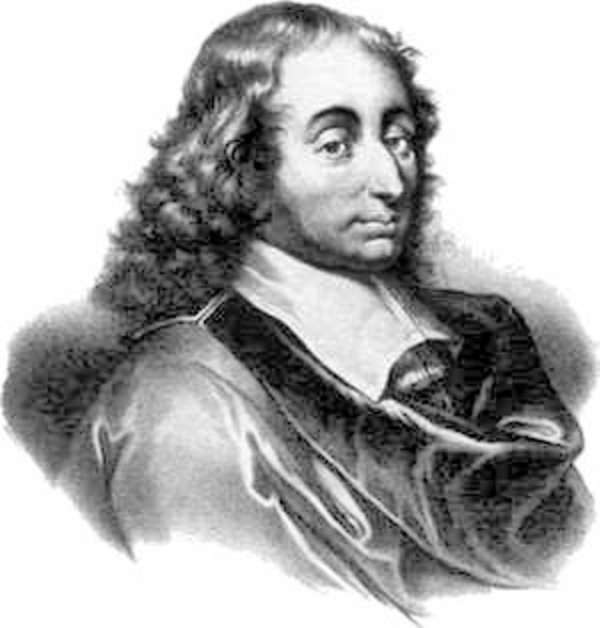
Not Proof but TrustJune 19 is the birthday of Blaise Pascal, the religious philosopher, mathematician, and physicist, born in France in 1623. Pascal invented lots of gadgets, including the syringe; the first mechanical calculator for sale to the public; the hydraulic press; and early forms of probability theory and integral calculus. Though his family wasn’t religious, he was so deeply impressed with two Christian mystics who cared for his father during an illness that he converted to Christianity. One night in November of 1654, he experienced a divine vision he later called a “night of fire.” He scribbled down a few poetic notes on a piece of paper, and then sewed the paper into the lining of his coat, the better to keep it close until his death. The year after his vision, he left Paris to live in the Abbey of Port-Royal, where he wrote his most famous (though unfinished) book, Pensées (“Thoughts”). Here are two of his thoughts: 1) If you don’t have faith, Pascal wrote, try acting as though you do. Do the things that a faithful person would do, and over time, you may well find your actions leading your heart and mind in faithful directions. In other words, don’t worry too much about what you believe; focus instead on your actions, on how you are living, and in time, your convictions will follow. 2) In what has become known as “Pascal’s Wager,” he argued that, while definitive proof of God’s existence exceeds our grasp, this shouldn’t surprise us. Whenever we face enormous, ultimate questions, we unavoidably find ourselves in a position of “wagering” on one perspective or another. And for Pascal, this is indeed the situation when it comes to God: we can’t conclusively prove that God does or doesn’t exist, and so either we bet on the idea that God is real, or we bet on the idea that God is a fantasy. If God is indeed real, Pascal reasoned, there’s a great deal to be gained by believing and acting as if God is real (and a great deal to be lost if we don’t!); and if God is a fantasy, there’s comparatively little lost no matter what we do. So it makes more sense to “wager” that God is real — and by extension, to live our everyday lives accordingly. This famous idea is often misunderstood as a kind of clever “proof” of God’s reality — but that’s the last thing it is. In fact, Pascal’s starting point is that such “proof” isn’t possible. Rather, his idea amounts to a recognition that genuine faith (like many important things in life!) doesn’t involve proof or definitive certainty, but rather a humble and courageous “betting our lives” on God, and ultimately on God’s call to live a beautiful, loving, dignified life. From the SaltProject.org Image: in the Public Domain
|
